I arrived for my conference in Denver on Friday night, and I pulled out my computer to do a little work. No matter what I did, I couldn't get the wireless to work in my hotel. I tried the lobby. I tried the room my friend was staying in, setting my computer in the very place that his computer successfully picked up wireless. I turned it on and off a couple of times, each time trying a few new settings. No luck. I called the technical support number, and after waiting a long time to speak to someone, I inadvertently hung up on the guy after five minutes of unsuccessful troubleshooting. When I tried to call back, the help line kept dropping me. I was ready to pull my hair out. I would have donated a kidney to someone who could fix my tech problem.
As I discussed this situation with my friend, I told him my theory about the two different responses people have when a techie helps them solve a computer problem. The first response is even greater anger once the problem is solved, because if the stupid $&!+$ had set up everything correctly to begin with, then there would have been no problem in the first place. The second response is typically my response, and that is to prostrate myself on the ground and worship the person who was smart enough to fix the problem. People who can fix these problems are like gods to me. And what I needed at that moment was a god. Maybe two.
I know that I should have been more loyal to my professed monotheistic religion—I shouldn't seek out strange gods from strange lands (the IT department doesn't get much stranger). Moreover, it is probably a wise practice to retain both of my kidneys. I felt remorse, and I tried to look for the moral I was supposed to learn from the situation. Maybe I was not meant to fix my computer. Perhaps it was heavenly intervention to keep my computer from contracting a deadly virus. Or to keep me from sending my contact information to Mrs. Martha Darling in Tunisia who needs help moving $4.3 million to the US. Or to get me to exercise a little as I jumped up and down in frustration.
Whatever the reason, the curse was mysteriously lifted Saturday morning, when for no reason I can discern, I was suddenly able to gain access to the Internet. 'Oh, how the penitent are blessed and succored,' I gleefully thought. Then I quickly put away my little impromptu shrine to Buddha and checked my email.
Monday, May 3, 2010
Wednesday, April 28, 2010
BR Cheap Ice Cream Night
Every year on April 28 Baskin' and Robbins has a 31 cent scoop ice cream night. In order to avoid the crowds, we decided to go early. So we had ice cream for dinner, and dinner for dessert.
Dinner never tasted this good!
Don't you wish you were here?
Tuesday, April 27, 2010
Mouse Chalk Art
Little J rediscovered the sidewalk chalk today and drew the mouse family. That hot mama mouse looks pretty hot!
Monday, April 19, 2010
Beaver damage
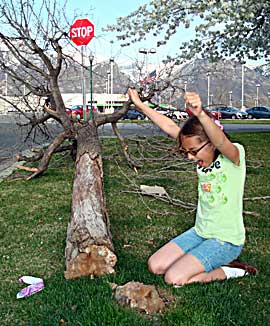
We've recently had trouble with some pesky beavers in our city. No one has seen them, but we're all pretty sure that there has been a rash of drive by gnawings. Animal rights activists have been advocating for tolerance until more evidence has been gathered. The rest of us think that it is time something was done about this outbreak of unregulated chewing. After all, there is already incontrovertible evidence in the PetSmart parking lot—a toppled, gnawed tree. Little J is seen below in a portrayal of how the crime was probably perpetrated.
The beaver poises above its unsuspecting prey.
The beaver decapitates its prey.
The beaver celebrates the wanton carnage.
Thursday, December 17, 2009
I'm finally a good teacher
I finally had a semester of teaching that I think my college would approve of. I admit that my colleagues would probably feel that I wasted a lot of time during the semester trying to help my students develop understanding of linear algebra, even though I had lots of evidence that they were learning the material better than any of the students in my previous nine classes. My students consistently performed well on tests and quizzes, and during group work in class, they expressed powerful insights into the material. I thought perhaps I was actually figuring out how to make the content of the course more accessible to students. I expected a strong performance on the final, particularly since the problems and questions on the exam were similar to the questions and problems on previous exams, as I had warned students they would be. I was ready to give out some of the best grades I have ever given in a linear algebra class.
But then a miracle happened that redeemed my teaching--my students bombed the final. I have no idea what happened to my bright students. They stumbled over problems they had successfully completed on previous exams. They overlooked conditions that we had discussed on at least four different occasions in class, both in small groups and whole class discussions. After I applied a fairly merciful curve to the final, the overall grades in the class were still a disappointment to me. I had expected that my students would do so much better than they had.
To my college, however, the overall grades of the course are resounding proof that the course was good. Recently when talking with the deans, a colleague asked what the deans thought of the teaching in our department. Rather than talking about the many innovations we have implemented or the overwhelmingly positive student evaluations we receive semester after semester, the deans instead chose to criticize our department for giving higher grades than any other department in the college. I should have expected that type of response, but at the time, it caught me off guard. I have this silly, naive notion that higher grades indicate that students are learning and understanding more than if they had lower grades. In other words, shouldn't high grades be a good thing? Shouldn't that be a natural phenomenon that accompanies good teaching?
But no, I'm wrong. A good course is one where many students fail, most get Cs and Ds, and none can ever mention the name of the course again without a shiver of dread going up their spine. That's a good course, because it's rigorous. And because it's rigorous, the only way students will survive and pass the course is because they learn the content. Or so the theory goes. And a wonderful byproduct of such a course is that it separates students so that we now know who deserves future opportunities and who doesn't. Never mind that perhaps many more would qualify for future opportunities if we focused more on actually helped students learn rather than making sure we sort them for employers and graduate school admission committees. Oh, there I go again with my wrong headed thinking. Stupid liberal tendencies.
At least this semester, though, I can pride myself on doing a good job in my class. I gave low grades, so my course must have been rigorous. Of course, I'll probably get good teaching evaluations from the students, like I usually do. Only this semester, my colleagues will attribute my high ratings to a good sense of humor rather than a propensity to give out easy As. No harm done, because I've become one of them. I've kept the system intact, perpetuated inequality, earned the respect of my colleagues. Of course, they'll wonder why I don't join them in bantering about the poor quality of students I've had this semester, and instead choose to sit in my office, lights off, staring at the wall. And in my darkened office, I'll continue to wonder when any of us will be smart enough and care enough to really make a difference in the lives of our students.
But then a miracle happened that redeemed my teaching--my students bombed the final. I have no idea what happened to my bright students. They stumbled over problems they had successfully completed on previous exams. They overlooked conditions that we had discussed on at least four different occasions in class, both in small groups and whole class discussions. After I applied a fairly merciful curve to the final, the overall grades in the class were still a disappointment to me. I had expected that my students would do so much better than they had.
To my college, however, the overall grades of the course are resounding proof that the course was good. Recently when talking with the deans, a colleague asked what the deans thought of the teaching in our department. Rather than talking about the many innovations we have implemented or the overwhelmingly positive student evaluations we receive semester after semester, the deans instead chose to criticize our department for giving higher grades than any other department in the college. I should have expected that type of response, but at the time, it caught me off guard. I have this silly, naive notion that higher grades indicate that students are learning and understanding more than if they had lower grades. In other words, shouldn't high grades be a good thing? Shouldn't that be a natural phenomenon that accompanies good teaching?
But no, I'm wrong. A good course is one where many students fail, most get Cs and Ds, and none can ever mention the name of the course again without a shiver of dread going up their spine. That's a good course, because it's rigorous. And because it's rigorous, the only way students will survive and pass the course is because they learn the content. Or so the theory goes. And a wonderful byproduct of such a course is that it separates students so that we now know who deserves future opportunities and who doesn't. Never mind that perhaps many more would qualify for future opportunities if we focused more on actually helped students learn rather than making sure we sort them for employers and graduate school admission committees. Oh, there I go again with my wrong headed thinking. Stupid liberal tendencies.
At least this semester, though, I can pride myself on doing a good job in my class. I gave low grades, so my course must have been rigorous. Of course, I'll probably get good teaching evaluations from the students, like I usually do. Only this semester, my colleagues will attribute my high ratings to a good sense of humor rather than a propensity to give out easy As. No harm done, because I've become one of them. I've kept the system intact, perpetuated inequality, earned the respect of my colleagues. Of course, they'll wonder why I don't join them in bantering about the poor quality of students I've had this semester, and instead choose to sit in my office, lights off, staring at the wall. And in my darkened office, I'll continue to wonder when any of us will be smart enough and care enough to really make a difference in the lives of our students.
Wednesday, December 16, 2009
Spies at work
I found this photo on the webpage of my place of employment, along with the question about whether these people are spies or not. Seems that underground remnants of the KGB have been successful in establishing a cryptography class at my university, and now they are openly training their young spies!
What is really disturbing is that the two women in this picture have actually worked as my TAs during the past year. I ask myself why they would want to work for me, of all people on campus. And then I made the connection--I am one of the few openly liberal people at my work, and I would be a natural sympathizer for their leftist cause.
Holy James-Bond-butt-kicking Russian spies! The commies are after me!
What is really disturbing is that the two women in this picture have actually worked as my TAs during the past year. I ask myself why they would want to work for me, of all people on campus. And then I made the connection--I am one of the few openly liberal people at my work, and I would be a natural sympathizer for their leftist cause.
Holy James-Bond-butt-kicking Russian spies! The commies are after me!
Tuesday, December 8, 2009
The Snowman Song
During the past few days, the first big snow storm of the winter season has moved through Utah Valley. I knew this storm was going to hit about a week before it did, because that's when I led the kids at my church in singing the snowman song.
I discovered the powers of the snowman song during late November of last year. Lawns across the valley had gone brown either from drought or frost. It was hard to say, because it had been a particularly dry fall. I decided to do something about it, so I had the kids at my church sing the snowman song forwards and backwards. I think it's the backwards rendition that makes it a particularly powerful spell. Anyway, during the next four weeks, we had five major snow storms. By the time the fourth one hit, I was wishing our song didn't have such powerful mojo. But I couldn't think of how to reverse the spell, since we had already sung the song in both directions to invoke the storms. We just had to suffer through it all.
This year's fall produced the same dismal looking lawns, so I once again took the weather into my own hands. Only this time I decided that maybe I could could temper the onslaught of storms by having only some of the kids sing the snowman song backwards and forwards. So I had only the older kids sing it during their singing time. But then the older kids also wanted to sing the lightening song*, and the scientist in me just couldn't resist performing the experiment. So far, we've had one big storm with no electric effects whatsoever. However, if we get a huge storm that knocks out the electricity, I'm not taking responsibility. After all, it was 11-year old Alex's idea. He made me do it.
*The lightening song is sung to the tune, Rain is Falling All Around, and the lyrics are as follows:
I discovered the powers of the snowman song during late November of last year. Lawns across the valley had gone brown either from drought or frost. It was hard to say, because it had been a particularly dry fall. I decided to do something about it, so I had the kids at my church sing the snowman song forwards and backwards. I think it's the backwards rendition that makes it a particularly powerful spell. Anyway, during the next four weeks, we had five major snow storms. By the time the fourth one hit, I was wishing our song didn't have such powerful mojo. But I couldn't think of how to reverse the spell, since we had already sung the song in both directions to invoke the storms. We just had to suffer through it all.
This year's fall produced the same dismal looking lawns, so I once again took the weather into my own hands. Only this time I decided that maybe I could could temper the onslaught of storms by having only some of the kids sing the snowman song backwards and forwards. So I had only the older kids sing it during their singing time. But then the older kids also wanted to sing the lightening song*, and the scientist in me just couldn't resist performing the experiment. So far, we've had one big storm with no electric effects whatsoever. However, if we get a huge storm that knocks out the electricity, I'm not taking responsibility. After all, it was 11-year old Alex's idea. He made me do it.
*The lightening song is sung to the tune, Rain is Falling All Around, and the lyrics are as follows:
Lightening's striking all around,Try it with your kids. I guarantee that even the boys will be singing.
On the housetops, on the ground.
Lightening strikes me on the head.
Now I'm falling toasty dead.
Subscribe to:
Posts (Atom)